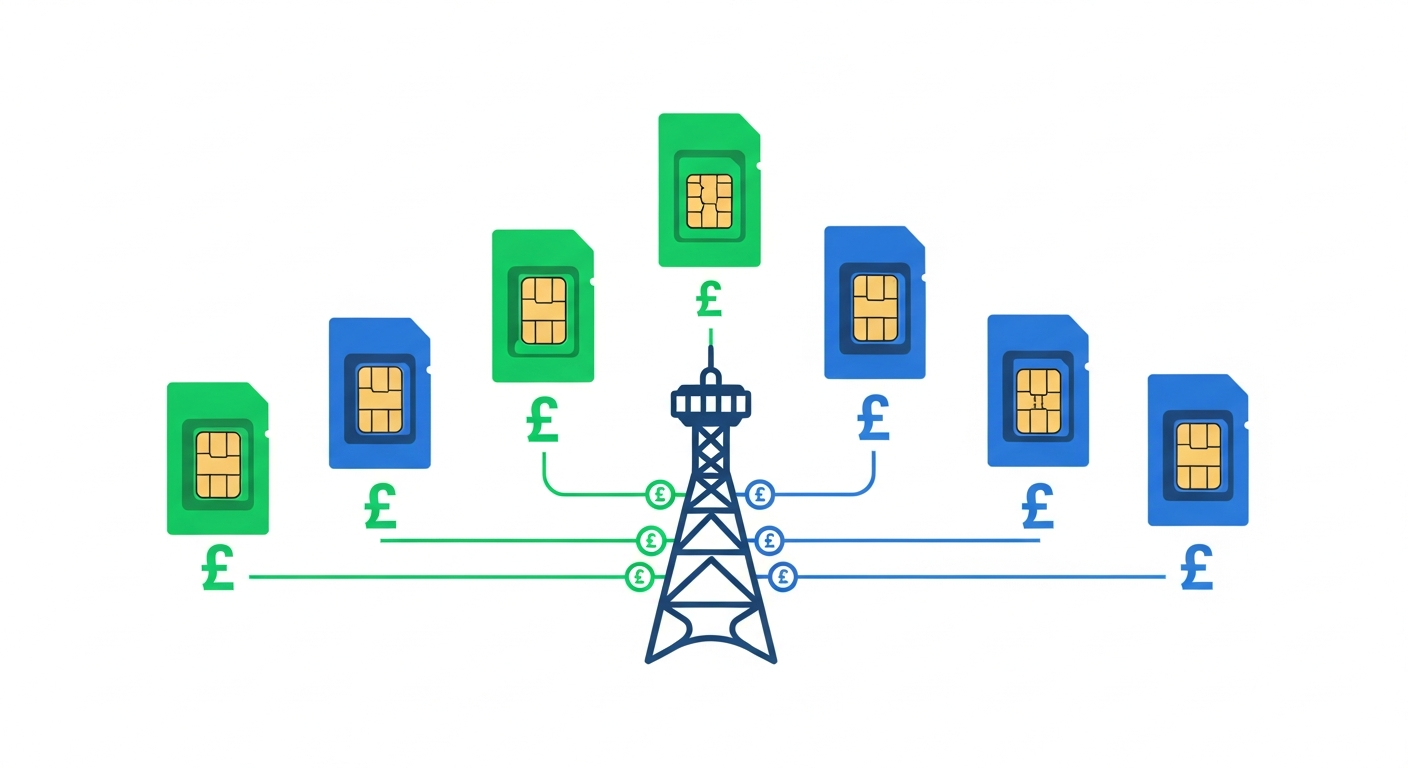
If you are paying more than you need to for your mobile phone plan, you are not alone. Millions of UK consumers stick with the big four networks out of habit, unaware that Mobile Virtual Network Operators (MVNOs) offer identical coverage at significantly lower prices. In this comprehensive guide, we examine every major UK MVNO in 2026, compare their plans and pricing, and help you decide whether switching could save you hundreds of pounds each year.
Key Takeaways
- MVNOs use the same masts and infrastructure as O2, EE, Vodafone, and Three but charge considerably less
- giffgaff, Smarty, and VOXI consistently offer some of the cheapest SIM-only deals in the UK
- Most MVNOs operate on rolling monthly contracts with no long-term commitment required
- Switching is simple and you can keep your existing phone number using a free PAC code
- You could save between £100 and £300 per year by moving from a major network to an MVNO
What Is an MVNO?
A Mobile Virtual Network Operator, commonly known as an MVNO, is a mobile phone provider that does not own or operate its own wireless network infrastructure. Instead, MVNOs purchase wholesale access to one of the four major UK networks (O2, EE, Vodafone, or Three) and resell mobile services to customers under their own brand name. This business model allows MVNOs to offer competitive pricing because they avoid the enormous capital expenditure required to build and maintain mobile masts, base stations, and core network equipment.
In the United Kingdom, MVNOs have become an increasingly significant part of the mobile telecommunications landscape. According to Ofcom's Communications Market Report, MVNOs collectively serve over 15 million subscribers across the country, accounting for roughly one in five mobile connections. This market share has grown steadily year on year as consumers become more aware of the savings available and as the quality gap between MVNOs and their host networks has effectively disappeared.
Some of the most recognisable MVNO brands in the UK include giffgaff, which operates on the O2 network; Smarty, which uses Three's infrastructure; Tesco Mobile, which has agreements with both O2 and Vodafone; Lebara, running on Vodafone's network; Sky Mobile, utilising O2's coverage; VOXI, a Vodafone sub-brand aimed at younger users; and iD Mobile, which operates on the Three network. Each of these providers offers a distinct combination of pricing, features, and customer experience whilst relying on proven network infrastructure that already serves millions of direct customers.
The concept of MVNOs is not unique to the UK. Virtual operators exist in markets around the world, but the UK's competitive regulatory environment and the presence of four well-established host networks have created particularly favourable conditions for MVNOs to thrive. Ofcom actively encourages competition in the mobile market, and MVNO agreements are a key mechanism through which this competition is maintained.
How Do MVNOs Work?
Understanding how MVNOs function requires a basic knowledge of mobile network architecture. The four major UK operators, often referred to as Mobile Network Operators (MNOs), own and maintain the physical infrastructure that makes mobile communication possible. This includes radio access networks comprising thousands of mobile masts and base stations, core network equipment that routes calls and data traffic, spectrum licences that grant permission to use specific radio frequencies, and backhaul connections that link individual masts to the wider internet.
MVNOs enter into commercial agreements with one or more of these MNOs to access their infrastructure. The exact terms of these agreements vary, but they typically involve the MVNO purchasing a wholesale allocation of network capacity. The MVNO then packages this capacity into consumer-facing plans, handles its own billing, customer service, marketing, and brand management. From the customer's perspective, calls are made and data is transmitted over exactly the same masts and frequencies as direct MNO customers use.
It is important to understand which MVNO operates on which network, because the underlying network determines your coverage, signal strength, and available speeds. Here is a clear breakdown of the major UK MVNOs and their host networks:
- O2 Network: giffgaff, Sky Mobile, Tesco Mobile (partial), Lycamobile
- Vodafone Network: VOXI, Lebara, Asda Mobile, Tesco Mobile (partial), Talkmobile
- Three Network: Smarty, iD Mobile, Superdrug Mobile
- EE Network: BT Mobile, Plusnet Mobile
One common concern is whether MVNOs experience slower speeds than direct MNO customers. In some cases, during periods of extreme network congestion, MNO customers may receive priority over MVNO customers for data traffic. However, independent testing by organisations such as Opensignal and Ookla has consistently shown that any speed difference is negligible for everyday use including streaming, browsing, and social media. The overwhelming majority of MVNO users report no perceptible difference in day-to-day performance compared to their previous MNO experience.
Complete Guide to UK MVNOs
giffgaff (O2 Network)
giffgaff has established itself as one of the most popular MVNOs in the UK since launching in 2009. Operating on the O2 network, giffgaff offers comprehensive 4G coverage across the country and has begun rolling out 5G access on selected plans in major cities. What sets giffgaff apart from many competitors is its community-driven approach: customers help each other through online forums, and the company rewards active community members with Payback points that can be redeemed as cash or credit.
giffgaff's pricing is straightforward and competitive. SIM-only plans, which giffgaff calls "goodybags," start from as little as £6 per month for 1GB of data, rising to £25 per month for unlimited data, calls, and texts. All goodybags include unlimited calls and texts as standard, with the only variable being the data allowance. There are no long-term contracts; every goodybag runs on a rolling monthly basis, giving customers complete flexibility to change or cancel at any time.
Pros: Excellent value pricing, no contract commitment, strong community support, O2's reliable coverage, golden goodybags for members, easy to set up and manage online.
Cons: Customer service is primarily community-based rather than dedicated support staff, 5G access is limited to higher-tier plans, no physical high street stores for in-person help, EU roaming incurs additional charges on basic plans.
Pro Tip: Use our Data Calculator to work out exactly how much data you need each month before choosing a giffgaff goodybag. Many people overpay by selecting more data than they actually use.
Smarty (Three Network)
Smarty is a relatively newer entrant to the UK MVNO market, having launched in 2017 as a direct subsidiary of Three. Operating entirely on Three's network infrastructure, Smarty benefits from Three's extensive 4G and growing 5G coverage. Smarty's unique selling point has always been simplicity and transparency: straightforward plans with no hidden fees, no speed caps, and a genuinely useful feature where unused data can be discounted from the following month's bill.
Pricing is where Smarty truly excels. Plans start from just £4 per month for 2GB of data, with unlimited data available from £10 per month, making it one of the cheapest unlimited data deals anywhere in the UK. All plans include unlimited calls and texts, and every plan operates on a one-month rolling contract with no minimum term. Smarty has also introduced 5G access at no extra cost on its unlimited plans, providing additional value for customers in areas with Three's 5G coverage.
Pros: Exceptionally low prices, unused data discount feature, no contract lock-in, 5G included on unlimited plans, honest and transparent pricing with no price rises during your plan.
Cons: Relies on Three's network which can be congested in urban areas, limited customer support options (online only), no inclusive roaming on cheaper plans, no physical stores, fewer additional perks compared to some competitors.
Tesco Mobile (O2/Vodafone Network)
Tesco Mobile occupies a unique position in the UK MVNO market as it operates across two major networks simultaneously. Tesco Mobile uses both O2 and Vodafone infrastructure, automatically connecting customers to whichever network provides the strongest signal in their location. This dual-network approach gives Tesco Mobile one of the widest effective coverage areas of any UK mobile provider, rivalling even the direct MNOs in terms of geographic reach.
Tesco Mobile offers both pay-as-you-go and contract options. SIM-only plans on a 12-month contract start from around £7.50 per month for 4GB of data, while larger data bundles and unlimited plans are available at competitive prices. One of Tesco Mobile's most attractive features for regular Tesco shoppers is its Clubcard integration: customers can collect Clubcard points on their monthly mobile bills and use Clubcard vouchers to pay for their mobile plans, effectively reducing the cost further.
Pros: Dual-network coverage providing excellent signal reliability, Clubcard integration for Tesco shoppers, family-friendly plans with discounts for multiple SIMs, good customer satisfaction ratings, availability of handset contracts alongside SIM-only.
Cons: Slightly higher prices than the cheapest MVNOs like Smarty, requires a 12-month contract for the best deals, Clubcard benefits only valuable if you shop at Tesco, 5G access is not yet widely available.
Lebara (Vodafone Network)
Lebara has carved out a distinctive niche in the UK mobile market by focusing on customers who make frequent international calls. Operating on Vodafone's network, Lebara provides solid 4G coverage nationwide and has built its brand around offering generous international calling minutes to over 40 countries as a standard inclusion in many of its plans. This makes Lebara particularly popular among expatriate communities and people with family and friends overseas.
Lebara's UK-focused plans are also competitively priced. SIM-only deals start from £5 per month for 2GB of data with unlimited UK calls and texts. Plans with international calling bundles start from around £5 per month and include hundreds of minutes to selected countries. Data-heavy plans with 15GB or more are available from £7.50 per month. All plans run on a 30-day rolling basis with no long-term commitment required.
Pros: Outstanding value for international calling, Vodafone's reliable network coverage, no contract required, competitive data pricing, multilingual customer support, good range of plans for different needs.
Cons: 5G access is not currently available, some international destinations require add-on purchases, online-only customer support, fewer UK-specific perks compared to giffgaff or Tesco Mobile, brand is less well-known than some competitors.
Sky Mobile (O2 Network)
Sky Mobile launched in 2017 and operates on the O2 network, offering 4G coverage across the UK. As a subsidiary of Sky, the mobile service is designed to integrate closely with Sky's broader entertainment ecosystem. Sky Mobile's standout feature is its "Roll" functionality, which allows customers to store unused data for up to three years, building up a data reserve that can be used in months when consumption is higher than usual.
Sky Mobile's pricing starts from around £6 per month for 2GB of data on a 12-month or 24-month contract. Larger data allowances are available, with 30GB plans typically priced around £15 per month. For existing Sky TV or Sky broadband customers, additional discounts apply, and Sky often bundles mobile plans with TV upgrades and broadband packages to create multi-service savings. Sky Mobile also provides access to Sky's entertainment content through its streaming apps.
Pros: Data Roll feature lets you save unused data for years, excellent for Sky TV and broadband customers through bundle discounts, O2's reliable network, Mix feature allows you to change your data plan weekly, access to Sky entertainment content.
Cons: Requires a contract rather than rolling monthly, less competitive on price for non-Sky customers, limited international calling options, 5G is available only in selected areas and on certain plans, less flexible than truly contract-free MVNOs.
VOXI (Vodafone Network)
VOXI is Vodafone's own youth-focused sub-brand, targeting customers aged 12 and above with plans that include "Endless" social media data. Operating on Vodafone's full network including 5G where available, VOXI stands out by offering unlimited data usage on social media and messaging platforms such as Instagram, TikTok, Snapchat, WhatsApp, and Facebook without it counting towards your monthly data allowance. This makes VOXI particularly appealing to younger users and heavy social media consumers.
VOXI's plans start from £10 per month for 45GB of data plus endless social media. For £15 per month, customers get 100GB of data plus endless social media and video streaming (YouTube, Netflix, Amazon Prime Video). The top-tier plan at £20 per month includes unlimited data with endless social media, video, and music streaming. All plans include unlimited UK calls and texts and operate on a rolling monthly contract.
Pros: Endless social media data on all plans, 5G access included at no extra cost, Vodafone's strong network coverage, no contract commitment, generous data allowances for the price, video and music streaming included on higher plans.
Cons: Slightly more expensive than the very cheapest MVNOs, the "endless" data only covers selected apps, no inclusive international calling, limited customer support options, annual price increases in line with CPI may apply.
iD Mobile (Three Network)
iD Mobile operates on Three's network and positions itself as a flexible, value-driven MVNO with an emphasis on data-heavy plans. Owned by Currys, the electronics retailer, iD Mobile benefits from high street visibility through Currys stores where customers can get in-person support and purchase SIM cards. This physical presence is a significant differentiator in a market where most MVNOs operate exclusively online.
iD Mobile offers a wide range of plans starting from around £4 per month for 1GB of data. Larger data allowances are competitively priced, with 20GB available from approximately £8 per month and unlimited data from £14 per month. iD Mobile provides both SIM-only and handset contracts, with the latter offering a broader selection of devices than most MVNOs. Plans are available on 1-month, 12-month, or 24-month terms, giving customers flexibility in how they commit.
Pros: In-store support through Currys retail locations, competitive pricing across all plan tiers, flexible contract length options, wide handset selection for device contracts, data rollover on selected plans, 5G access available on compatible plans.
Cons: Three's network can be congested in busy urban areas, some plans require a 24-month commitment for the best price, EU roaming charges apply, customer service quality can be inconsistent, fewer unique perks than some competitors.
MVNO vs Major Network: Pros and Cons
When deciding whether to switch from a major network operator to an MVNO, it helps to see the key differences laid out clearly. The following comparison table summarises the main advantages and disadvantages of each option to help you make an informed decision.
| Factor | MVNOs | Major Networks (O2, EE, Vodafone, Three) |
|---|---|---|
| Monthly Cost | Typically 30-60% cheaper for equivalent data | Premium pricing with plans starting from £20-35/month |
| Contract Flexibility | Most offer 30-day rolling contracts | Usually 12 or 24-month minimum terms |
| Network Coverage | Identical to host network | Full access to own network infrastructure |
| 5G Access | Available on some MVNOs (VOXI, Smarty, giffgaff) | Included on most current plans |
| Customer Support | Primarily online and app-based | Phone, online, in-store, and app support |
| EU Roaming | Varies widely; some charge extra | Generally included with fair usage caps |
| Extras and Perks | Fewer loyalty perks and entertainment bundles | Priority access, streaming bundles, loyalty rewards |
| Handset Deals | Limited; most focus on SIM-only | Wide range of subsidised handset contracts |
| Speed During Congestion | May be slightly deprioritised at peak times | Priority access to network capacity |
| Best For | Budget-conscious users, SIM-only customers | Users wanting full-service experience and perks |
Use our Network Comparison Tool to see detailed side-by-side pricing for your specific data requirements, or try the Bill Analyser to see exactly how much you could save by switching to an MVNO.
Which MVNO Is Best for You?
Choosing the right MVNO depends entirely on your personal priorities, usage habits, and what matters most to you in a mobile plan. There is no single best option for everyone, but the following decision guide will help you narrow down the best choice based on your specific needs.
If Your Priority Is the Lowest Possible Price
Smarty is the clear winner for budget-conscious customers. With unlimited data from just £10 per month and basic plans starting from £4, Smarty consistently undercuts almost every other provider in the UK market. The added benefit of unused data discounts means you could pay even less if you do not use your full allowance. giffgaff is also an excellent budget choice, particularly if you prefer O2's network coverage over Three's.
If You Make International Calls
Lebara is purpose-built for international callers. With inclusive international minutes to over 40 countries bundled into affordable plans, no other UK MVNO matches Lebara's value for overseas calling. If your calling needs are more occasional, giffgaff also offers reasonable international rates through add-on packages.
If You Are a Heavy Social Media User
VOXI's endless social media data feature makes it the standout choice for social media enthusiasts. Whether you spend hours scrolling through TikTok, posting Instagram stories, or video calling on WhatsApp, none of this usage counts against your data allowance. For users who consume most of their data through social platforms, VOXI can effectively provide an unlimited experience at a mid-range price point.
If You Want the Most Reliable Coverage
Tesco Mobile's dual-network approach, utilising both O2 and Vodafone infrastructure, provides arguably the most comprehensive coverage of any MVNO. If you frequently travel across the UK or live in an area where one network is stronger than another, Tesco Mobile's ability to switch between networks gives it a distinct advantage. Sky Mobile is also a strong choice if you are already in the Sky ecosystem and want dependable O2 coverage.
If You Want In-Store Support
iD Mobile is the best option if you value being able to visit a physical store for help with your mobile service. Through its partnership with Currys, iD Mobile offers face-to-face customer support at hundreds of locations across the UK, a rarity among MVNOs that predominantly operate online.
How to Switch to an MVNO
Switching to an MVNO is a straightforward process that Ofcom has worked hard to simplify for UK consumers. The entire process typically takes less than 24 hours and you can keep your existing phone number throughout. Here is a step-by-step guide to making the switch.
Step 1: Check Coverage
Before committing to any MVNO, verify that the underlying host network provides good coverage at your home, workplace, and other locations you frequently visit. Use the coverage checker on the host network's website (O2, Vodafone, Three, or EE) rather than the MVNO's own site, as this will give you the most accurate information. Our Network Coverage Guide can also help you understand what to look for.
Step 2: Request Your PAC Code
To keep your existing phone number, you need a PAC (Porting Authorisation Code) from your current provider. The quickest way to get this is to text the word PAC to 65075 from the mobile number you wish to transfer. Your current network is legally required to respond with your PAC code within one minute. The code is valid for 30 days. For a detailed walkthrough of this process, see our comprehensive PAC Code Guide.
Step 3: Choose Your Plan and Order a SIM
Select the MVNO and plan that best suits your needs based on the comparisons above. Order a SIM card from your chosen provider, which is typically free of charge and arrives within one to three working days. Many MVNOs also offer eSIM options for compatible devices, allowing you to activate your new plan instantly without waiting for a physical SIM card to arrive.
Step 4: Activate and Port Your Number
When your new SIM arrives, follow the MVNO's activation instructions and provide your PAC code when prompted. Your old number will automatically transfer to your new SIM, usually within one working day. During the porting process, you may experience a brief period (typically a few hours) where your service is interrupted, so it is advisable to start the process in the morning to ensure completion the same day.
Step 5: Set Up and Optimise
Once your number has transferred, insert the new SIM into your phone (or activate the eSIM) and check that calls, texts, and data are all working correctly. Download the MVNO's app if available, as this is usually the easiest way to manage your account, track your usage, and change your plan if needed. Make sure Wi-Fi calling is enabled in your phone's settings for the best possible indoor coverage.
Pro Tip: If you are out of contract, there is no early termination fee to pay when switching. Use our Contract Checker to find out whether you are still within your minimum term before requesting your PAC code.
Frequently Asked Questions
Are MVNOs as reliable as major networks?
Yes, MVNOs use exactly the same physical network infrastructure as the major operators. A giffgaff customer uses the same O2 masts and equipment as a direct O2 customer. The main difference is in customer service, extras, and occasionally data speed prioritisation during peak times. In practice, most users will not notice any difference in call quality or data reliability between an MVNO and its host network.
Can I keep my phone number when switching to an MVNO?
Absolutely. You can keep your existing phone number by requesting a PAC (Porting Authorisation Code) from your current provider. Since 2019, Ofcom regulations require all UK networks to provide your PAC code via text within one minute when you text PAC to 65075. Once you give this code to your new MVNO, your number will transfer within one working day. For full instructions, see our PAC Code Guide.
Do MVNOs offer 5G access?
Some MVNOs now offer 5G access, but not all. VOXI provides 5G at no extra cost on its plans, as does Smarty on selected plans. giffgaff began rolling out 5G access in 2024 on its higher-tier plans. However, many MVNOs still only offer 4G connectivity. If 5G access is important to you, check with the specific MVNO before signing up, as availability varies by provider and plan.
What happens if I have poor signal with an MVNO?
If you experience poor signal with an MVNO, the issue is with the underlying host network's coverage in your area rather than the MVNO itself. You can check coverage before signing up using the host network's coverage checker. Most MVNOs offer 30-day rolling contracts, so you can easily switch if coverage does not meet your expectations. Wi-Fi calling is also available on many MVNOs, which can help with indoor coverage issues.
Are there any hidden costs with MVNO plans?
Reputable UK MVNOs are generally very transparent about pricing. However, there are a few things to watch out for: some MVNOs charge extra for international calls, roaming data abroad may not be included or may cost more than on major networks, and some promotional prices increase after an initial period. Always read the terms carefully and check what happens to your price after any introductory offer ends. Ofcom rules require providers to notify you before any price changes take effect.